For twenty years I worked for a family business — a prominent union contractor in New York. For nearly ten of those years, I watched the union hold on the market slip, quietly, season after season. In 2014 I built an algorithm to measure it. I have refined it every year since. And not long ago I left the only world I'd ever worked in, because I'd come to believe the thing I could measure was too important to keep to myself.
The method is the same one I used to use to estimate jobs: measure each trade by the actual scope of work it performs. Much of that scope sits, at least partly, in the public record — but no one has ever assembled it into a single picture of the market as a whole. Hundreds of firms each hold a piece. Nobody sees the board. I spent a decade putting it together, one trade at a time — plumbing, fire suppression, mechanical, structural, general construction — every building trade I could measure by what it actually installs.
What it shows points, more than any single factor I know of, at one of the real causes of the housing slowdown we're all living through. But the number isn't where this starts. It starts with how little anyone agrees on it.
No one had measured it. They had only felt it.
Ten years of carrying this work around has put me in front of some of the most influential developers and labor organizations in the city. I almost always ask the same thing: what do you think the union share of the market actually is?
The answers scatter. The layperson still pictures a city that's ninety-five percent union. The owners and the tradespeople know better — they can feel that it's moved — but they can't put a number on it. Some are curious. Some get angry. And some simply don't believe the question has an answer at all.
"I've studied this for nearly forty years, and you're the only one who's been able to measure the thing I've felt all along — that the unions no longer control the market."
— a labor attorney, after four decades in the field
That gap — between what the industry feels and what it can prove — is the whole problem. A market no one can measure is a market no one can reason about. Policy gets written against a memory of the market instead of the market itself. And the memory is twenty years out of date.
The outer boroughs were a training ground. Open shop graduated.
After 2008, the weight of the city's development shifted. The Brooklyn renaissance and the rise of Long Island City — powered by 421-a — set off a housing boom in the outer boroughs. The union trades had built their agreements around the high-rise world of Sixth Avenue. They largely passed on the residential towers going up across the river. They'll never build them without us, went the thinking.
They built them. Again and again, the open-shop trades practiced and sharpened their craft on exactly the work the union trades had waved off. Year by year they gained ground, until they weren't the cheap alternative anymore. They were simply the option.
Then 2020 stopped the world. I remember a major interiors executive saying on camera that he had no work — and in my corner of the industry, that was the signal. I'd seen what a downturn does to this market once before, in the 2010–2012 numbers: open shop takes another leap, and the union share never fully comes back. When 421-a lapsed in June 2022, the large open-shop organizations that had been thriving on housing didn't disappear. They went looking for work — and found it back on Sixth Avenue, in the office towers the union agreements were supposed to protect.
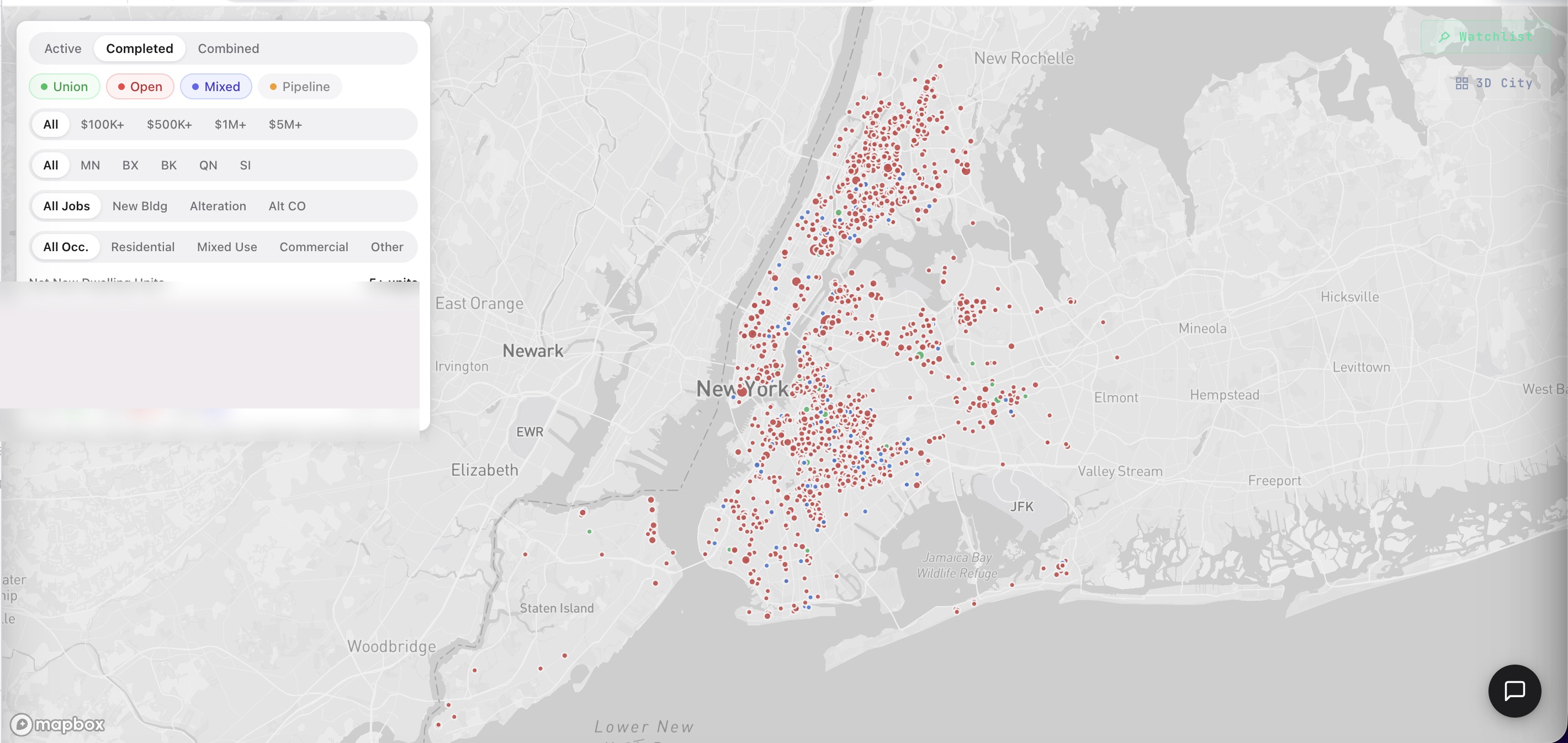
Construction is a market, like any other.
At bottom, this is ordinary economics. When times are good and asset prices climb, spending on labor climbs with them. When a recession comes, spending pulls back — and so, intuitively, should the price the market will pay for its most expensive labor. Measure it, and you can watch that happen. The difference between a union contractor and an open-shop one is, more than anything else, where they work — and far less than most people assume, anything else.
The harder truth for organized labor is structural. A downturn doesn't just lower the union share for a year. It builds large, capable open-shop organizations that outlast the recovery — and when the next housing program lapses, they don't fold. They move upmarket. The ratchet only turns one way.
The rule is written for a market that's already gone.
When 421-a lapsed, its replacement became 485-x. Before it was finalized, that same attorney asked me to brief some of the people shaping it on the real union share of the market. I was still a union contractor then, and I held back most of what I knew. Labor pressed, through political pressure, for a better deal — and got one.
You can see the result in the filings now. The wage requirement switches on at one hundred apartments, so building after building stops at ninety-nine — one short of the line. It isn't a secret; it's reported openly, and the surge of 99-unit filings is plain in the record. We should be doing that work — we pay fair wages, the union trades say. They do pay fair wages. But the market had already moved. Developers had spent a decade learning that open-shop scope came in around 20% cheaper, and had gotten genuinely good at the work. The foothold was lost around 2010. A statute wishing otherwise won't bring it back.
I want to be careful here, because it's easy to read this the wrong way. The union trades are not the villain of the housing slowdown. If anything they're a casualty of the same shift everyone else is living through — and I say that as someone who spent his whole career among them. The problem isn't who builds. It's that a wage rule meant to protect a union-majority market is still written as if that market were intact. That mismatch — not greed on anyone's part — is what bends a building down to ninety-nine units, or keeps it from filing at all.
Which leaves the question the whole debate keeps circling without naming: what is prevailing wage actually pegged to — and what happens to housing when it's pegged to a market that's already changed underneath it?
I'm not writing this to bury the trades I came from. I'd have stayed if I still believed the old story were true.
I'm writing it because a market no one can see is a market no one can fix — and the people paying for that blindness are the New Yorkers who can't find a place to live. Construction can be measured, building by building, the same as any other market. Someone has to knock down the first domino.
I left a good job to be that someone.